
CPS-BLOG-A07
Who Can Receive a Crew Allotment — and Why the Beneficiary Must Be Understood Separately
The crew member authorises an allotment, but another person or organisation may receive it through a specific bank account. Understanding those distinctions makes beneficiary screening and review more useful.

A crew-allotment beneficiary is often a member of the seafarer’s family. But “often” is not the same as “always” — and the difference matters when a company needs to understand who will actually receive the payment.
A crew member joins a vessel. The company completes its employment and onboarding process. The crew member then asks for part of their wages to be sent regularly to someone ashore.
It is easy to compress that into a familiar story:
crew member → family member → bank account
And very often, that may be exactly what the instruction represents.
But it is not the complete picture.
The Maritime Labour Convention, 2006 describes a system through which seafarers can transmit all or part of their earnings to their families, dependants or legal beneficiaries. The language is deliberately broader than “spouse” or even “family.”
Depending on applicable law, company policy and the seafarer’s circumstances, the nominated recipient encountered in an allotment workflow may be a spouse or parent. It may also be another relative, a friend, a creditor, an institution, a charity, a representative or another authorised recipient.
None of those categories makes the payment suspicious.
It does mean that the person or organisation receiving the money should not disappear behind the crew member’s identity.
The company may know the crew member very well. It may know considerably less about the allotment beneficiary.
That difference is where the operational question begins.
“Isn’t a crew-allotment beneficiary normally just a family member?”
Often, yes.
Family support is one of the most familiar reasons for transmitting a seafarer’s wages ashore. But a common case should not quietly become the system’s only assumed case.
Even the legal and regulatory language used to describe allotments tends to leave room for more than one family relationship. The MLC refers to families, dependants or legal beneficiaries. The UK Maritime and Coastguard Agency’s guidance on seafarers’ wages, for example, explains that seafarers covered by the relevant UK rules may allot wages to one or more nominated persons and that the remittance is made directly to those persons.
The precise recipient categories and requirements will differ by jurisdiction, employment arrangement and company policy. The useful operational point is simpler: the process should be able to represent the recipient who was actually nominated, rather than forcing every instruction into a “family member” assumption.
Takeaway: Family may be the most familiar beneficiary category, but it is not a safe universal assumption for crew allotments.
“If the crew member authorised the allotment, why does the beneficiary’s identity matter separately?”
Because authorisation and identity answer different questions.
The crew member’s instruction tells the company that the transfer was requested. It may establish the amount, frequency, nominated account and whatever approval the company’s process requires.
It does not make the crew member and the beneficiary the same party.
If Priya Nair asks for part of her wages to be sent to Arun Nair, the company has at least two people in the workflow. The shared surname may help someone understand the instruction, but it does not prove the relationship or establish who Arun Nair is.
If the payment is instead directed to an organisation, the distinction is even harder to miss. The employer’s relationship is with the crew member. The payment instruction may confer a financial benefit on a separate individual or entity.
And there is another distinction inside the payment details themselves:
- the crew member authorises the allotment;
- the beneficiary is the person or organisation intended to receive the money; and
- the payment destination is the particular bank account and receiving-bank route through which it will be sent.
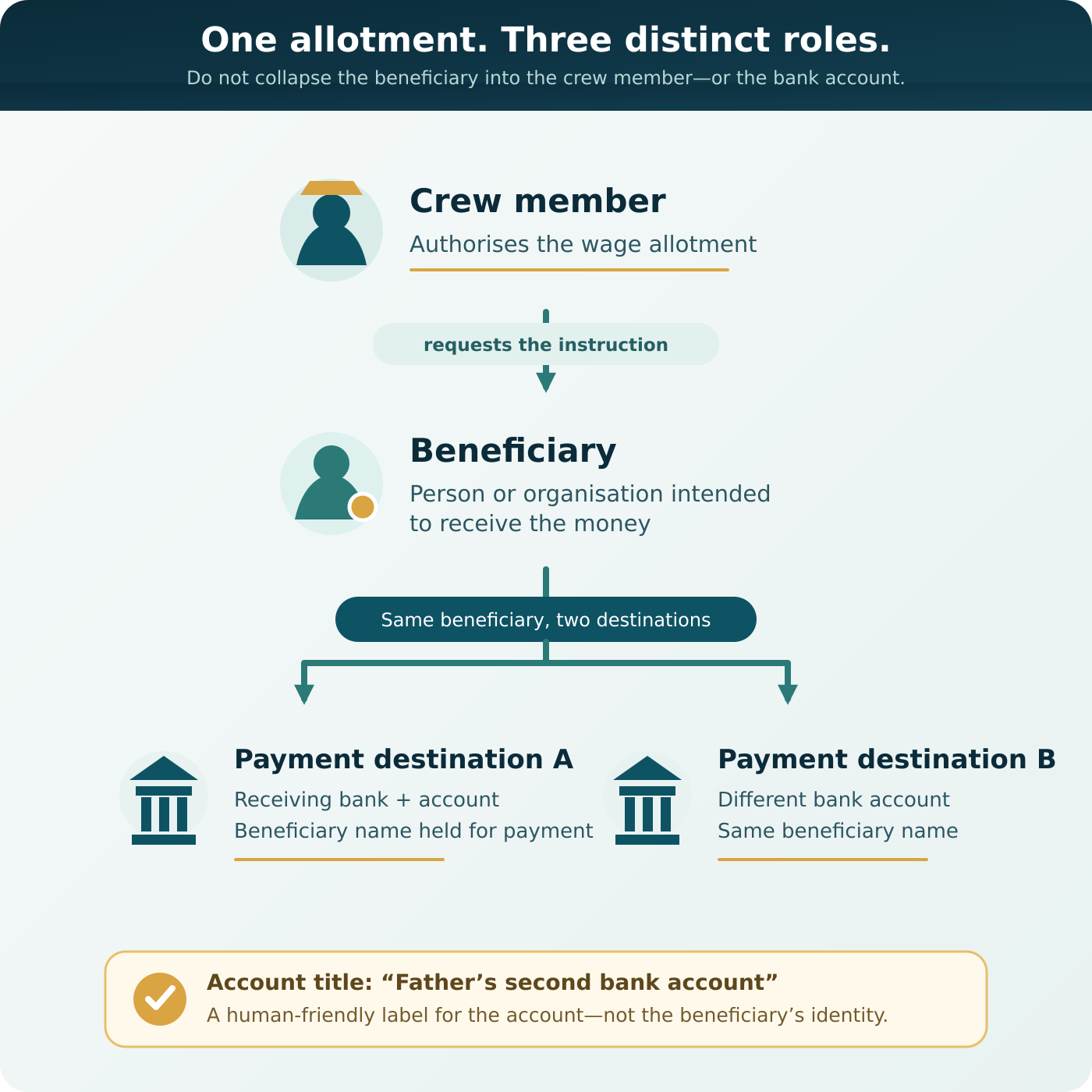
One beneficiary may have more than one payment destination. If a crew member registers two bank accounts for the same parent, the beneficiary name may be the same in both entries while the account and receiving-bank details differ.
This does not invalidate the crew member’s authorisation. It explains why authorisation should not be asked to do the work of beneficiary identification — or why one beneficiary name should not be treated as if it identifies one unique bank account.
Takeaway: An authorised allotment tells the company who requested the payment; it does not, by itself, identify the beneficiary and the particular payment destination clearly enough.
“Haven’t we already checked the crew member?”
Perhaps. But crew onboarding and beneficiary review are not substitutes for one another.
The company may hold a rich employment record for the seafarer: legal name, date of birth, nationality, identity documents, address, seafarer number, employment history and vessel assignment.
The beneficiary and bank-account information may be much lighter: perhaps a beneficiary name, an account number, a receiving bank and a relationship or payment-purpose description.
That relationship or purpose is commonly useful context. But it is still context supplied within the crew member’s allotment instruction; it is not a substitute for the beneficiary name used for the payment.
The asymmetry is understandable. The beneficiary is not applying for employment and should not automatically be subjected to the crew member’s complete onboarding process. Collecting unnecessary personal data would create its own privacy and security burden.
But the answer cannot be to pretend that checking the employee also checked every person or organisation nominated to receive part of the employee’s wages.
The better question is whether the company holds enough relevant information for the control it has chosen to perform — and enough to investigate a possible match without starting from a nearly empty entry.
Takeaway: A well-known crew member and a lightly documented beneficiary are two different information positions, even when they appear in the same allotment workflow.
“Does a non-family beneficiary make the payment higher-risk?”
Not automatically.
A payment to a creditor may reflect a legitimate obligation. A payment to a friend may reflect how a household or personal arrangement actually works. An institution or charity may be easier to identify than an individual with a common name. A family beneficiary with incomplete or outdated details may be harder to investigate than any of them.
Relationship or payment-purpose information can provide useful context. It should not become a crude suspicion score.
Treating every non-family recipient as inherently problematic would produce poor decisions and unnecessary work. It could also obscure the actual issue: whether the nominated recipient and payment details are sufficiently clear, current and consistent with the company’s policy.
The category helps someone understand the instruction. It does not decide whether the payment is permitted.
Takeaway: Beneficiary variety is an information and workflow concern — not evidence that an ordinary allotment is suspicious.
“Why might the beneficiary name be difficult to recognise or screen?”
Names do not arrive in one tidy global format.
A beneficiary name may be:
- entered in a different order from the name on an identity document;
- shortened to fit a bank or payroll field;
- transliterated from another script in more than one valid way;
- recorded with or without a middle name, patronymic or family name;
- entered under an organisation’s trading name instead of its legal name; or
- preserved differently across the crew-management system, payroll output, payment draft and bank file.
There may also be a human-friendly account title such as “Father’s second bank account.” In some crew-management systems, that title helps authorised users recognise which account is being referenced without necessarily giving every user access to the beneficiary’s name or sensitive bank details.
That account title is not the beneficiary’s identity. For screening and payment purposes, the meaningful value is the beneficiary name as held for the bank account, together with whatever additional identifiers the company appropriately retains.
The recipient may also have a perfectly ordinary name shared by many other people.
A name-similarity result is therefore only a candidate for examination. OFAC’s guidance on evaluating a possible match tells reviewers to compare the complete sanctions entry with all available information, which may include addresses, nationality, passport or tax identifiers, places and dates of birth, former names and aliases. UK financial-sanctions guidance similarly distinguishes a name match from a target match by looking at other identifying details.
If the allotment information contains little more than a shortened beneficiary name, the screening tool has less information with which to distinguish a real concern from an unrelated namesake.
That does not mean the company must collect every possible identifier for every beneficiary. It means data quality affects both what screening can find and how efficiently a human can resolve what it returns.
Takeaway: An account title can help a user recognise an account, but screening must use the beneficiary’s identity — and secondary identifiers are often what allow a reviewer to resolve a possible match.
“What information should the company retain about a beneficiary?”
There is no universal field list for every maritime company, jurisdiction or allotment.
The useful principle is proportionality: retain enough information to administer the instruction, support the company’s chosen controls and investigate exceptions — without collecting personal data merely because a database has another empty field.
Depending on the recipient and the company’s policy, useful information may include:
- the beneficiary name as supplied and as held for the bank account;
- whether the beneficiary is an individual or an organisation;
- the relationship or payment-purpose context supplied with the instruction;
- a human-friendly account title, where the system uses one for usability or access-control purposes;
- country and address information where available and relevant;
- additional identifying information needed under the applicable workflow;
- receiving-bank name, country and stable bank identifiers where available;
- the account or payment identifier needed to execute the allotment;
- who created, changed and approved the instruction; and
- the history of material changes and previous review decisions.
In many crew-management systems, the beneficiary and receiving-bank details are kept together as one practical beneficiary/account entry. That structure is useful for payment operations, but the meaning still matters.
Two entries bearing the same beneficiary name may represent the same person using two different bank accounts. A changed account may represent a new payment destination without representing a new beneficiary. Conversely, a familiar account title does not prove that the beneficiary name and banking details beneath it are unchanged.
Not every information item belongs in every entry. Some may be inappropriate to collect without a clear purpose. Retention and access should also follow the company’s privacy, security and legal requirements.
Still, an instruction consisting of little more than “A. Santos, Bank A” may be cheap to create and expensive to investigate at payment cut-off.
Takeaway: The goal is not maximum beneficiary data; it is enough purposeful information to distinguish the beneficiary, the payment destination and the history that supports review.
“What context might the company have that the bank does not?”
The bank has important information and controls of its own. It may know more about the payment route, correspondent relationships, account activity and the requirements governing its part of the transaction.
The company, however, may hold the operational story behind the instruction:
- which crew member nominated the beneficiary;
- what relationship or purpose was supplied;
- which beneficiary name is held for the selected bank account;
- whether the beneficiary has another registered payment destination;
- when the beneficiary or bank-account information was created or changed;
- which supporting information was obtained;
- who approved the change;
- whether the same beneficiary has received earlier allotments; and
- whether a previous possible match was investigated and how it was resolved.
Some of that context may never be present in the payment message sent to the bank.
That is why company-side and bank-side controls are complementary. The bank should make its independent decision using the information and obligations available to it. The company can use the information available earlier in its own workflow to understand the recipient and selected payment destination before the instruction reaches the bank.
Takeaway: The bank sees and controls important parts of the transaction; the company may be better placed to explain how that beneficiary and bank account entered the payment workflow.
“Where could beneficiary screening fit without creating another heavy process?”
The answer should not be to reopen every beneficiary/account entry manually before every payment.
A more practical design uses the events that already matter in the workflow.
The first useful moment may be when a beneficiary or payment account is created, or when material information changes. That gives the company an opportunity to identify missing data and resolve an exception before a payment deadline is close.
The second useful moment may be when the account is selected for a current payment draft. That check can consider whether the beneficiary details, receiving-bank information, relevant sanctions sources or the company’s policy have changed since the earlier decision.
Previous screening and human-review history should travel with the beneficiary/account entry. An unchanged candidate that was reasonably investigated earlier should not necessarily return as if nobody has ever seen it. A genuinely new name, identifier, sanctions entry or material account change should not be hidden behind an old green tick.
This is where CrewPayScan is intended to fit: alongside the existing crew-management, payroll and payments process, helping the company maintain a current screening state for the actual beneficiary and receiving-bank information connected to an allotment payment.
The authorised people in the company would still decide what to clear, hold or escalate. The bank would still apply its own controls. CrewPayScan would support the comparison, review history and evidence; it would not make the legal decision or guarantee that a bank would process the payment.
Takeaway: A useful control checks the actual beneficiary and selected payment destination when the instruction meaningfully changes and when the payment becomes current — while preserving what the company already knows.
The beneficiary should not be a footnote to the crew member
A crew allotment begins with the seafarer’s wages and authority.
But the resulting payment does not necessarily end with the seafarer.
It may benefit a second person or an organisation. That recipient may have a different name, country, legal identity, relationship and information history from the crew member who created the instruction. The same recipient may also have more than one registered bank account.
That difference is neither unusual nor inherently suspicious. It is simply real.
The practical test is to look at an organisation’s own allotment information and ask:
- Can we distinguish the crew member from the actual beneficiary?
- Can we distinguish the beneficiary’s identity from an account title created for convenience or restricted visibility?
- If one beneficiary has multiple bank accounts, can we identify the payment destination selected for this instruction?
- Can we see what information was supplied, what later changed and who approved it?
- If a name produces a possible match, do we hold enough relevant context to investigate it?
- When the payment becomes current, can we show what was checked and what supported the release decision?
If those questions can be answered from the existing workflow, the company already has a useful foundation.
If they cannot, the first improvement may not be “more screening.” It may be more basic: ensure that the allotment process preserves a clear understanding of the beneficiary, the selected payment destination and the history of both.
Because the crew member explains why the instruction exists.
The payment information should explain who will actually receive the money, where it will be sent and what the company knows about that decision.
Sanctions obligations, employment rules and permitted allotment arrangements differ according to jurisdiction, parties and payment. This article discusses operational control design and does not constitute legal advice.
Exploring a similar crew payment screening workflow? Request a private preview to share how your team handles beneficiary and bank-name checks today.